
Capabilities
Hot and cold forging, 150 to 1600 tonnes.
Presses from 150 to 1600 tonnes, tooling designed and manufactured in house, and a long-standing finishing network inside the same manufacturing cluster.
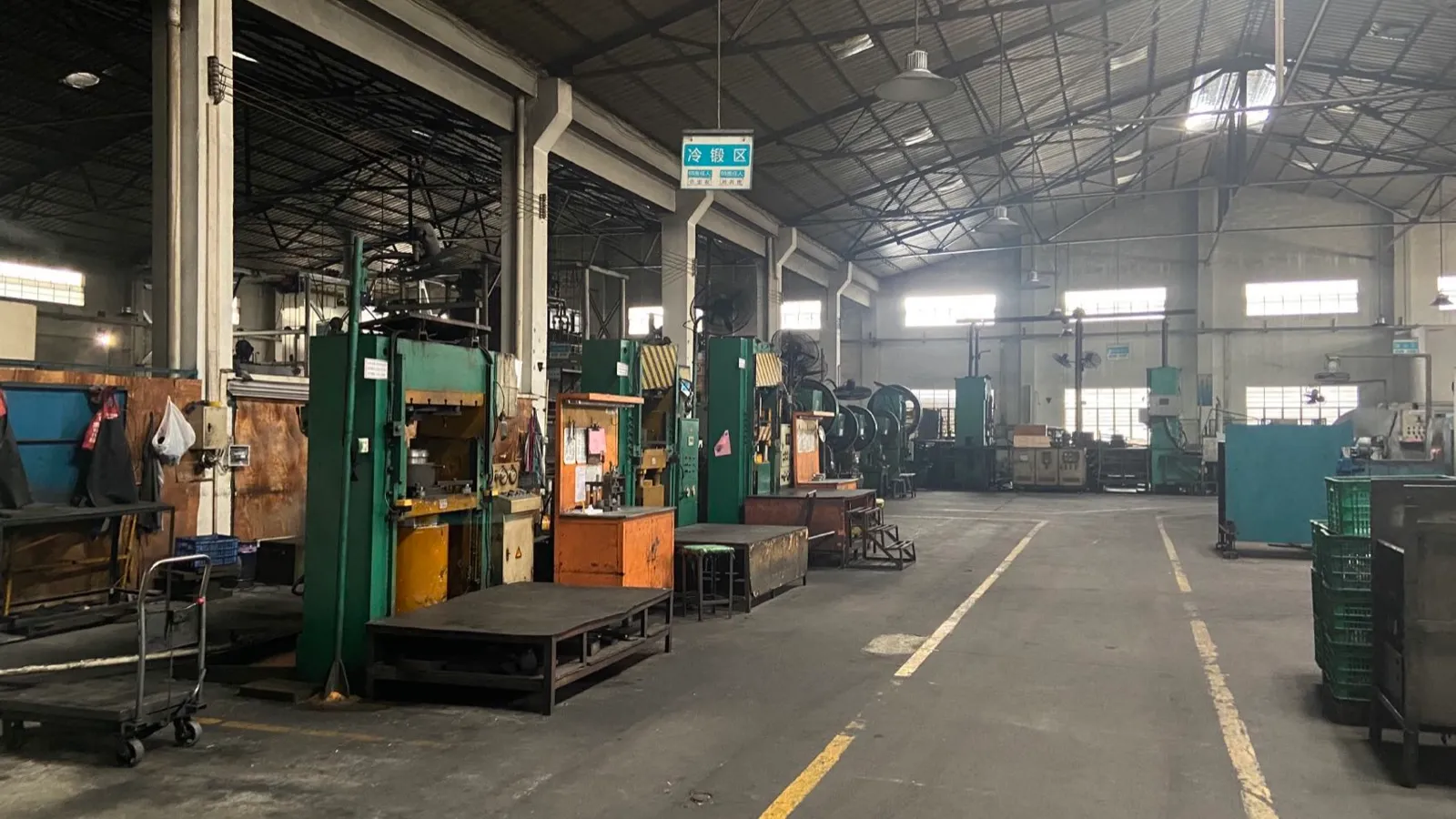
Cold forging bay, on our own shop floor
Processes
Processes
Hot forging
Formed above the recrystallisation temperature. Usually chosen for more complex geometry or heavier sections, where formability matters more than as-forged dimensional accuracy.
Cold forging
Formed at room temperature. The material work-hardens, repeatability is usually good and material utilisation is high. Suits regular geometry at higher volumes.
Liquid die forging
Forms liquid or semi-solid aluminium alloy under pressure. The structure is dense with low porosity, and yield is typically 98% or higher. Suits complex parts that need higher strength or gas-tightness.
Equipment
Equipment
| Capacity | Type |
|---|---|
| 1600 T | Hot friction screw press |
| 630 T | Electric screw press |
| 500 T | Special hydraulic press |
| 400 T | Electric screw press |
| 300 T | Hydraulic press |
| 150 T | Mechanical press |
What a press can form depends on projected area, alloy, section thickness and die design together, so it cannot be reduced to a single maximum size. Send a drawing and we will review it.
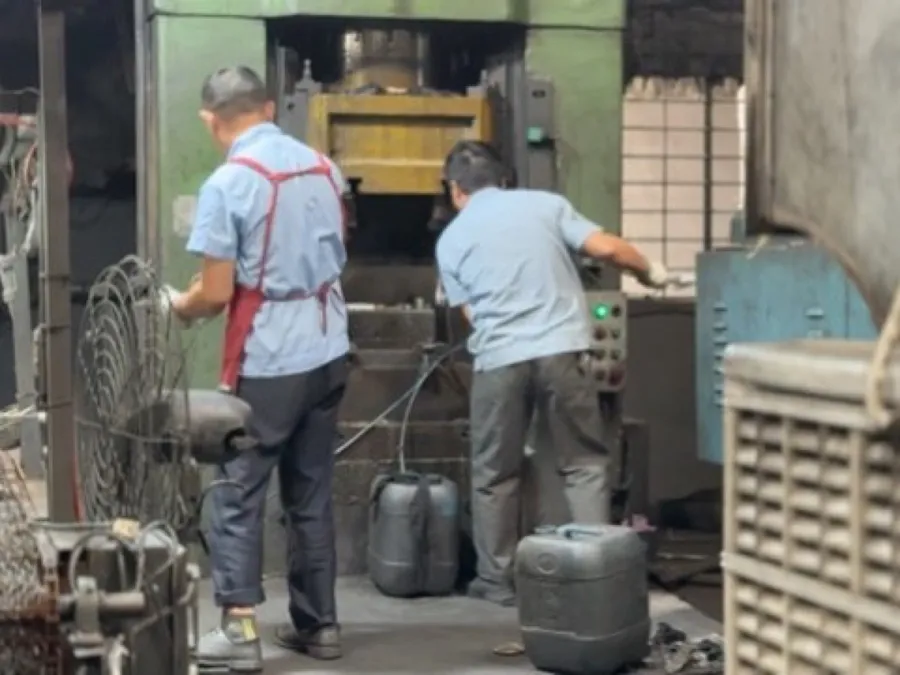
Tolerance reference
Typical tolerances, cold vs. hot forging
These are the typical ranges the process can usually hold. Actual tolerance still depends on part geometry, alloy and die design together — final numbers come from reviewing your drawing.
| Item | Cold forging | Hot forging |
|---|---|---|
| Dimensional · linear | 0.03–0.1 mm | 0.2–1.0 mm |
| Roundness / diameter | 0.05–0.1 mm | — |
| Flatness | 0.005–0.3 mm | 0.25–0.5 mm |
| Surface roughness | Ra0.8–0.4 | Ra3.2–6.3 |
| Parallelism | 0.05–0.3 mm | 0.25–0.3 mm |
| Perpendicularity | 0.05–0.2 mm | 0.25–0.3 mm |
| Concentricity | ±0.1–0.2 mm | ±0.2–0.3 mm |
| Machining stock, per side | 0–0.5 mm | 0.3–2.5 mm |
Hot forging does not affect the alloy’s anodising response, and cold-forged parts anodise essentially the same as the parent material.
Alloys we work with
Alloys we work with
- 7075
- 7005
- 6061
- 6082
- 5056
- 5052
- 4032
- SFDZ0010
- AHS-2
- 3003
- 2024
- 2014
- 1050
- 1070
Which alloy suits a given part depends on its geometry, the forging method, the heat-treatment condition and the service environment. We go through that against your drawing.
Tooling
Tooling and die development
Dies are designed and manufactured in house, which keeps the feasibility loop short — when a geometry needs adjusting to forge cleanly, the people who cut the die are in the same conversation.
Process selection
When is forging worth considering?
Forging earns its place on some parts and not on others. These are the conditions where it is usually worth reviewing.
- The part carries repeated or fatigue loading
- Structural strength has to be held while controlling weight
- The part is sensitive to material continuity — porosity, gas holes and inclusions are not acceptable
- Near-net shaping would reduce the material removed in machining
- It runs in volume and needs consistent part-to-part behaviour
- The part needs machining followed by anodised colour finishing
- You would rather manage one interface than several suppliers
And when it is not
Not every aluminium part needs to be forged. For simple geometry, low loads, very small quantities or parts driven mainly by appearance, another process may suit you better. We review the drawing, material, service conditions and expected volume before recommending forging.